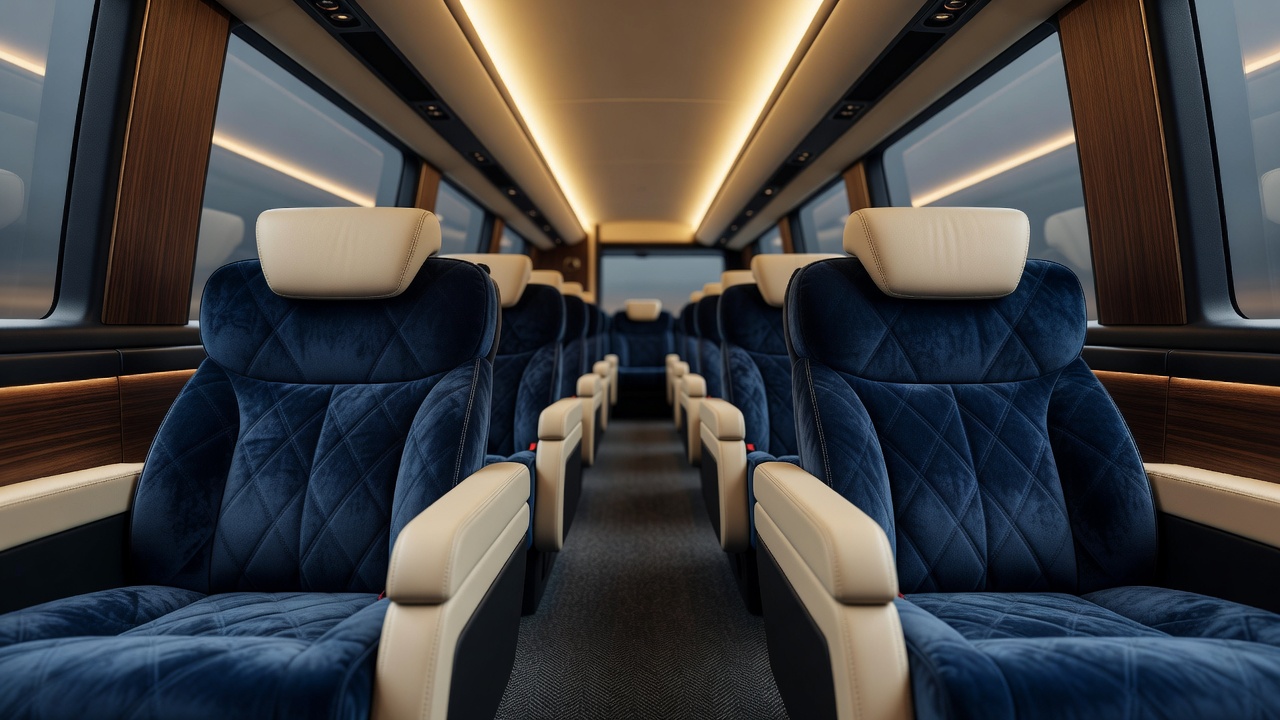
The Geometry of Seat Pitch
When assessing passenger comfort in the commercial transport sector, the paramount metric is spatial allocation. Within the constraints of a standard 12-to-14-meter coach chassis, operators must perform a precise geometric balancing act: maximizing revenue-generating seats without causing intolerable physical distress to the customer.
The critical measurement here is 'seat pitch'—the distance from any point on a seat to the exact same point on the seat in front of it. Standard long-distance bus operators typically offer a seat pitch between 29 and 32 inches, highly comparable to economy-class aviation standards. However, the dynamics of bus travel alter the perception of this space. Unlike aircraft, where passengers are confined for largely predictable durations, long-distance bus travel often involves varied terrain, frequent stops, and shifting road conditions, making muscular fatigue a compounding issue.
In response to consumer demand, a sub-segment of 'premium' operators has emerged, offering enhanced pitches of 36 to 40 inches. This is achieved by reducing the standard row configuration from a 2+2 layout to a 2+1 layout, sacrificing overall capacity for a higher yield per ticket and significantly improved lateral shoulder room.
Recline Mechanisms and Lumbar Support
Beyond static space, the kinetic capability of the seat dictates long-haul viability. The recline angle on a standard coach seat is usually limited to between 10 and 15 degrees. While sufficient for daytime routes, this angle is physiologically inadequate for achieving the deep REM sleep required on overnight 'sleeper' routes.
The fundamental problem with traditional recline mechanisms is their negative impact on the passenger behind. A standard recline directly encroaches upon the usable space of the aft seat, often rendering tray tables unusable and laptop work impossible. Forward-thinking manufacturers are increasingly adopting 'cradle' seating architectures. Instead of the seatback merely pivoting backward, the entire seat pan slides forward as the back reclines, maintaining the passenger’s center of gravity within their own designated space envelope. This preserves the structural integrity of the cabin layout while offering superior lumbar pressure distribution.
Environmental Controls: HVAC and Ambient Noise
Physical space is only one component of the ergonomic equation; the ambient environment plays an equally vital role. Managing the Heating, Ventilation, and Air Conditioning (HVAC) system across a cabin containing upwards of fifty individuals—each with varying metabolic rates and thermal preferences—is a significant engineering challenge.
Modern coach designs address this through micro-zoning. Rather than relying solely on a central thermostat that blasts chilled air indiscriminately, newer models utilize localized directional vents, often integrated directly into the overhead reading light cluster. This allows for personalized thermal regulation. Furthermore, high-grade particulate filters have become standard, not just for pathogen mitigation, but to scrub the cabin air of diesel exhaust fumes that can permeate during slow-moving urban traffic.
Acoustic management is another critical, often overlooked factor. The droning frequency of a heavy-duty diesel engine, combined with high-speed wind sheer and tire friction, can induce severe auditory fatigue over a six-hour period. Manufacturers utilize specialized acoustic baffling in the chassis floor, double-glazed window panels, and vibration-dampening seat mounts to lower the interior decibel level. While active noise-cancellation is left to the passenger's personal headphones, the baseline acoustic environment of a 2026-era coach is markedly quieter than its turn-of-the-century predecessors.
Onboard Connectivity and Amenities
As the primary demographic for long-distance bus travel shifts toward younger, digitally native professionals, the definition of 'comfort' has expanded to include digital connectivity. A seat is no longer just a place to sit; it is a mobile workstation.
The standard amenity baseline now demands, at minimum, individual power delivery. Historically, this meant a shared 110V/220V AC outlet between seats. Modern configurations favor dedicated, high-wattage USB-C ports embedded in the seatback or armrest, eliminating the need for bulky charging bricks. Onboard Wi-Fi, once a premium novelty reliant on spotty 3G networks, now utilizes bonded 5G cellular arrays capable of maintaining stable connections for baseline browsing and email, though bandwidth-heavy video streaming often remains structurally throttled to ensure equitable distribution among all passengers.
Finally, the inclusion of onboard lavatories remains a non-negotiable requirement for routes exceeding three hours. The engineering focus here has been on chemical odor neutralization and space-efficient modular designs that minimize the footprint without compromising basic sanitation standards.