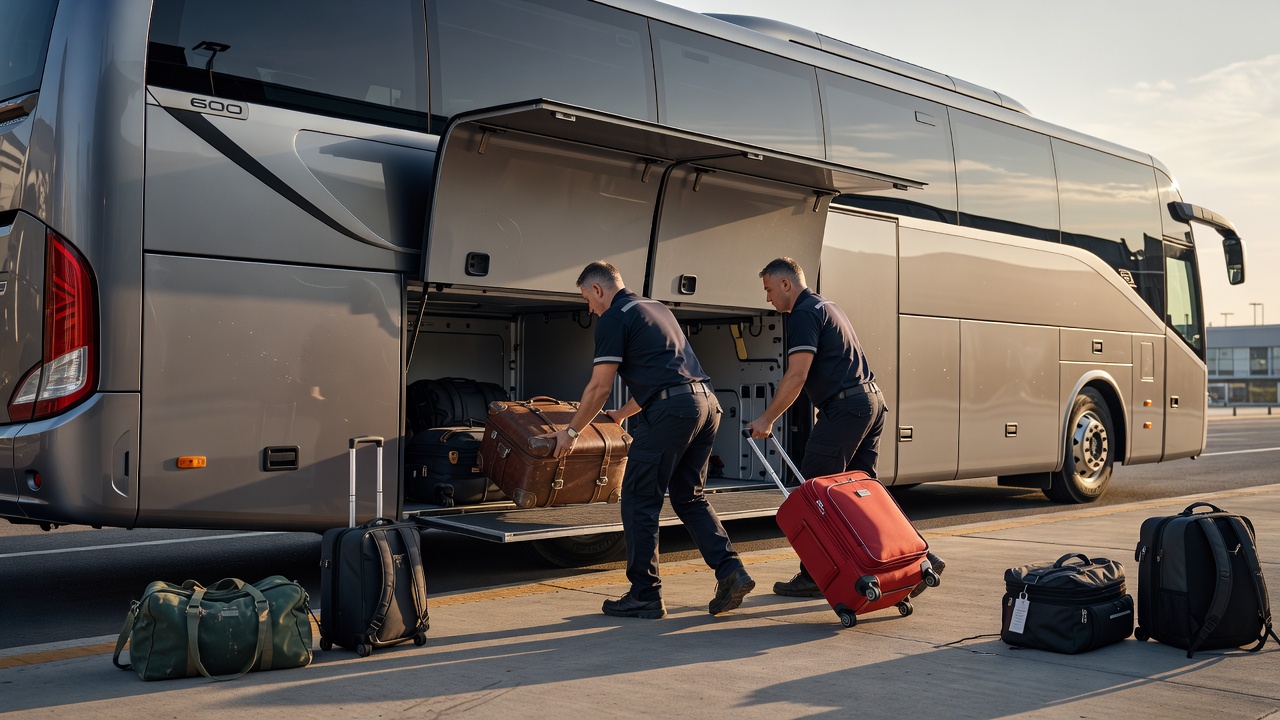
The Spatial Economics of the Hold
Unlike commercial aircraft, which utilize standardized Unit Load Devices (ULDs) for automated freight handling, passenger buses rely on a decidedly analog, manual process for luggage loading. The undercarriage space—or the "hold"—is a finite volumetric asset. How an operator manages this space directly influences their pricing strategy, their scheduling reliability, and ultimately, their operational margin.
A standard intercity coach typically offers between 10 and 15 cubic meters of secure under-floor luggage capacity. When divided by a maximum capacity of roughly fifty passengers, the mathematical baseline dictates an allowance of one large suitcase per traveler, with a small degree of buffer room. Deviations from this baseline require strict procedural and financial regulations.
Carry-On Constraints and Cabin Physics
The management of space begins inside the cabin. Overhead racks on modern buses are distinctly different from the enclosed bins found on commercial aircraft. Due to headroom restrictions and safety regulations preventing heavy items from becoming projectiles during rapid deceleration, bus overhead racks are generally shallow and un-enclosed.
This structural limitation strictly defines carry-on allowances. Items are typically restricted to soft-sided bags, small backpacks, and personal items (such as laptops or briefcases) that can fit securely under the seat or resting on the open rack. Passengers accustomed to the standard "roller bag" allowed as an aircraft carry-on frequently find themselves required to check these items into the bus undercarriage. Operators must clearly communicate this disparity in their ticketing interfaces to prevent boarding delays caused by passengers attempting to force oversized luggage into the cabin.
Structuring Baggage Allowances
To prevent volumetric exhaustion in the hold, the industry has universally adopted a tiered allowance system. The standard ticket generally includes one piece of checked luggage (typically capped at 20-25 kg, governed as much by occupational health and safety limits for the driver loading the bag as by vehicle weight distribution limits) and one personal carry-on item.
Excess baggage is treated as a premium ancillary revenue stream. Operators employ dynamic pricing for additional bags, incentivizing passengers to declare extra luggage during the online booking process rather than at the curb. Curbside additions are notoriously disruptive; they require immediate payment processing by the driver and introduce unexpected volumetric variables that can delay departure. By charging a premium for undeclared curbside bags, operators use pricing as a behavioral lever to ensure predictability.
Oversized Items and Micro-Freight
The transport of specialized, oversized items—such as bicycles, skis, musical instruments, and large strollers—presents a unique logistical challenge. These items possess high volumetric inefficiency; a single bicycle box can consume the space of four standard suitcases.
To manage this, operators implement strict quota systems. A route may only have a global allocation for two oversized items per journey, available on a first-come, first-served basis during the booking phase. Some modern fleet models are equipped with specialized rear-mounted racks designed specifically for bicycles, thereby removing them entirely from the undercarriage equation and freeing up valuable hold volume for standard luggage or lucrative micro-freight.
Micro-freight—the practice of utilizing unsold undercarriage space to transport commercial packages or urgent courier documents between city hubs—represents a growing secondary revenue channel. Operators leverage their predictable, high-frequency schedules to offer same-day parcel delivery services that compete favorably with traditional logistics carriers on specific point-to-point corridors.
Security, Liability, and Tracking
The decentralized nature of curbside loading introduces distinct security vulnerabilities. Because luggage is often loaded at public transit points rather than secure, sterile zones (as in airports), the risk of theft or accidental misplacement is elevated.
Liability for lost luggage is usually heavily capped in the operator's terms of carriage, often limited to a nominal per-kilogram rate rather than the actual replacement value of the contents. To mitigate claims and improve customer trust, the industry is slowly migrating toward digital bag-tagging systems. By affixing a barcode tag to the bag and linking it to the passenger's digital ticket profile, drivers can use handheld scanners to verify that the correct bag is being offloaded at the correct destination, drastically reducing human error in multi-stop route profiles.